
Rated capacity, body width and oil flow decide which skid steer loader fits a site. How 365 kg to 1,300 kg machines compare, and the numbers behind them.
Skid steer loaders are sold on horsepower and on rated operating capacity. Neither tells you whether the machine fits through the gate, fills the bucket you need or runs the attachment you already own. Capacity, width and hydraulic flow decide that.
Buy the smallest machine that meets three numbers: rated capacity at the load centre you work at, a body width that clears your narrowest access, and enough auxiliary flow for the most demanding attachment on your list. Landscape and residential work: 1,320 kg, 365 kg rated, a 752 mm body and 57.6 L/min. Bulk sand, gravel and demolition debris: 3,300–3,800 kg, 950–1,200 kg rated, 70–78 L/min and a 1.47 m body. One class above costs width, weight and fuel every day; one class below costs a bucket that never fills and an attachment that stalls.
What does rated operating capacity actually mean?
Rated operating capacity is a stability rating, not a lifting record. Manufacturers publish it at 50% of tipping load, the convention in SAE J818, so a loaded machine keeps a margin with the arms up and the ground imperfect. The ratio on this range runs from 50% to 57%: the HS35 is rated 365 kg against 680 kg, the HS75 950 kg against 1,900 kg, and the HT75 1,300 kg against 2,300 kg. Two machines with the same rating can therefore behave differently at the limit.
Three conditions sit behind the number: the load at the stated load centre, measured forward from the bucket pivot or coupler face; the height the rating assumes, because capacity falls as the arms rise; and firm, level ground with correct tyre pressure. Move the load forward with pallet forks, hang a breaker on the coupler or work across a slope and the usable figure drops below the brochure. Quotes are measured at different load centres, so ask for the load centre before comparing brands.
Which size class fits your work?
The range runs from a 1.3 t machine rated at 365 kg to a 4.0 t machine rated at 1,300 kg. Weight roughly triples as capacity doubles: the ability to fill a 0.56 m³ bucket costs about two and a half tonnes of steel.
| Model | Rated load | Tipping load | Operating weight | Bucket | Aux. flow | Width (body / tyres) |
|---|---|---|---|---|---|---|
| HS35 | 365 kg | 680 kg | 1,320 kg | 0.20 m³ | 57.6 L/min | 752 / 901 mm |
| HS50 | 760 kg | 1,500 kg | 3,003 kg | 0.35 m³ | 70 L/min | 1,469 / 1,740 mm |
| HS75 | 950 kg | 1,900 kg | 3,300 kg | 0.56 m³ | 70 L/min | 1,469 / 1,740 mm |
| HS85 | 1,050 kg | 2,020 kg | 3,550 kg | 0.56 m³ | 78 L/min | 1,497 / 1,817 mm |
| HS100 | 1,200 kg | 2,200 kg | 3,800 kg | 0.56 m³ | 78 L/min | 1,497 / 1,817 mm |
| HT60 | 1,100 kg | 2,100 kg | 3,900 kg | 0.56 m³ | 70 L/min | 1,880 mm (tracked) |
| HT75 | 1,300 kg | 2,300 kg | 4,000 kg | 0.56 m³ | 78 L/min | 1,880 mm (tracked) |
| YH430 | 430 kg | not published | 1,430 kg | 0.17 m³ | 33 L/min | 1,200 mm body |
The 365 kg class is a one-bucket-at-a-time machine for gardens, driveways and indoor work. Its 752 mm body and 901 mm width across the tyres pass openings that stop everything else, and its 0.20 m³ bucket matches the load it can carry.
The 760–950 kg class is the general contractor's machine. A 0.35–0.56 m³ bucket moves topsoil, gravel and palletised material at a pace that pays for the machine, and 70 L/min runs an auger, a breaker or a grapple without compromise. The 1,050–1,300 kg class adds reach and dump height rather than speed: 2,543–2,551 mm clears a high-sided truck the smaller machines cannot reach.
The YH430 sits between the groups: 430 kg rated, 1,430 kg operating weight, a 0.17 m³ bucket, 25 MPa system pressure and a 30° climb rating. It suits mixed farms and rental fleets that need one compact machine for many jobs rather than maximum output on one.
How much does width cost you?
Every spec sheet gives two widths and buyers read the wrong one. Body width is the machine; track width is the distance across the tyres, usually 250–320 mm wider. The first decides whether you enter the site. The second decides how the machine sits on a trailer deck and how stable it feels on a cross-slope.
On this range the body goes from 752 mm on the HS35 to 1,469 mm on the HS50, HS60 and HS75, and 1,497 mm on the HS85 and HS100. Across the tyres those figures become 901 mm, 1,740 mm and 1,817 mm. The tracked HT models are wider again at 1,880 mm over the tracks, with a 1,830 mm bucket. A 1.47 m body does not pass a 1.5 m gate once the arms and mirrors are counted, and 1.74 m across the tyres is wider than many light plant trailer beds. Measure the narrowest point on the route, then the trailer.
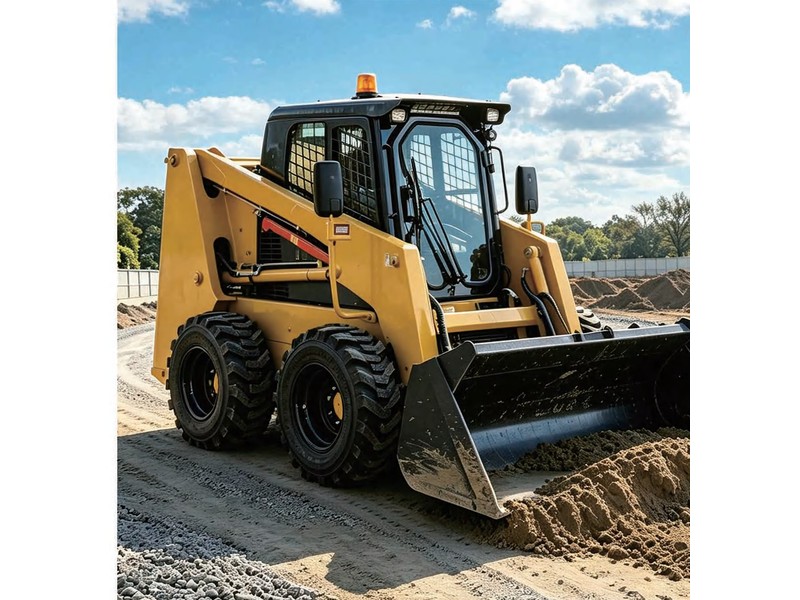
Weight is the second half of access. A 1,320 kg machine and a 3,800 kg machine need different trailers, tow vehicles and, in many markets, licences. Operating weight excludes bucket, operator and fuel, so add 150–250 kg for a loaded bucket when checking the trailer plate.
Wheeled or crawler?
Most of the range runs on tyres, from 600-9 on the HS35 to 10.0-16.5 on the HS75, at 12–12.4 km/h. Tyres suit yards, roads, concrete and mixed sites: cheap to replace, they do not damage surfacing, and the machine travels between jobs under its own power.
The tracked line is the HT60 and HT75: 3.9–4.0 t machines rated 1,100–1,300 kg on 320 mm crawler tracks, 1,880 mm wide and 10 km/h. They carry more than the equivalent wheeled machine and put that load on a much larger footprint, which is what soft ground, slopes and finished landscaping need. The price is 2 km/h of travel speed, track wear on abrasive surfaces and an undercarriage that costs more to maintain than four tyres.
The ME380A is the small crawler: 875 kg, a 0.15 m³ bucket and a 24 hp petrol engine. It is the machine for tight gardens and turf where a 1.88 m tracked loader cannot go.
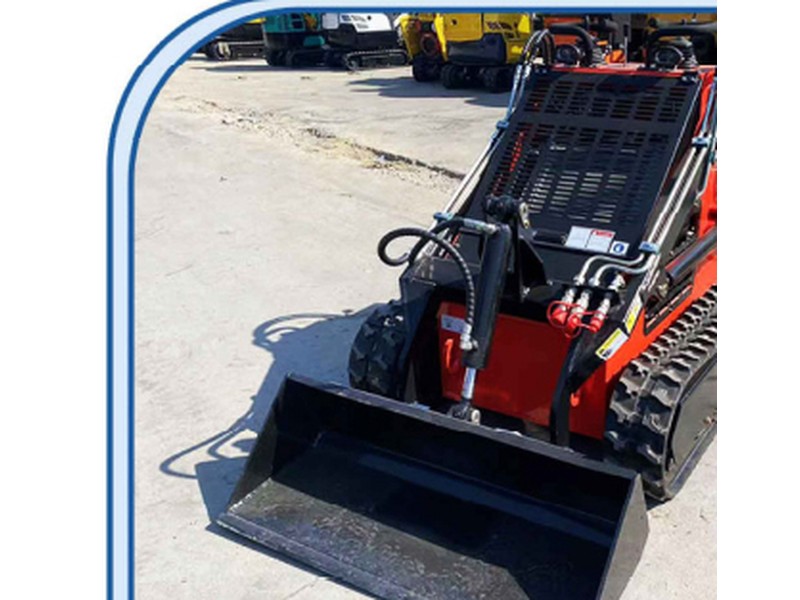
If the work is 80% hard surface, buy tyres and accept slow progress on wet days. If it is the other way round, the crawler earns its maintenance cost. The same logic applies to excavator undercarriages, covered in the rubber versus steel tracks comparison.
How much hydraulic flow do your attachments need?
Auxiliary flow is where cheap machines fail in service. The compact end of this range runs 25–33 L/min; the 3.3–4.0 t machines run 70–78 L/min. That threefold spread decides which attachments work rather than merely fit.
| Attachment | What to check before you buy | Why it matters |
|---|---|---|
| Earth auger | Required flow, output rpm and maximum torque | A small motor on 78 L/min runs hot; on 25 L/min it stalls in clay |
| Hydraulic breaker | Flow window and pressure range, not just 'fits a skid steer' | Excess flow overheats the oil; low pressure gives weak blows |
| Trencher | Continuous flow plus a case drain line | Without a case drain the motor seal fails early |
| Grapple or 4-in-1 bucket | Number of auxiliary circuits and coupler type | One circuit cannot clamp and lift independently |
| Sweeper or planer | Flow at rated engine speed, not at idle | These are the highest-demand attachments in the list |
Two rules save expensive mistakes. Compare flow at the same engine speed — a figure at 3,000 rpm and one at 2,500 rpm are not comparable, and eco mode typically costs 20–30% of flow. Then check pressure: the YH430 runs 25 MPa, the YH800 17 MPa, and an attachment set up for one will not perform on the other.
Couplers matter too. Flat-face couplers are the current standard and connect more easily under residual pressure; older agricultural pattern couplers still appear on imported attachments. Match them, or budget for adaptors and the restriction they add.
How much bucket can you actually use?
Bucket volume and rated capacity are two different limits, and the material decides which one you hit first. A 0.56 m³ bucket on the HS75 is rated for 950 kg. Fill it with dry sand at 1,500 kg/m³ and you are carrying 840 kg before the bucket is heaped. Fill it with gravel and the load is 896 kg, leaving 54 kg of margin. Heap either one and you are over the rating.
| Material (loose) | Typical bulk density | 0.35 m³ bucket | 0.56 m³ bucket |
|---|---|---|---|
| Dry sand | 1,500 kg/m³ | 525 kg | 840 kg |
| Gravel | 1,600 kg/m³ | 560 kg | 896 kg |
| Crushed stone | 1,600 kg/m³ | 560 kg | 896 kg |
| Topsoil | 1,200 kg/m³ | 420 kg | 672 kg |
| Bark mulch | 500 kg/m³ | 175 kg | 280 kg |
On dense material the bucket limits before the machine, and a bigger bucket makes it worse. On light material the opposite: 0.56 m³ of bark mulch weighs 280 kg, two thirds of capacity unused, so a larger bucket or a grapple is right. Work out density first, then specify bucket width to match the tyres, not the body.
What should you check before the machine ships?
- Weigh it loaded. Ask for a weighbridge ticket with the standard bucket fitted and a full tank. Catalogue weight and shipped weight are rarely identical.
- Flow-test at the couplers. A flow meter at the auxiliary couplers, at rated engine speed, shows what the pump actually delivers. Do it before the machine leaves.
- Check the relief valve setting. It should match the published system pressure. A valve backed off to mask a weak pump is a common shortcut.
- Compare bucket width to tyre width. A narrower bucket leaves material under the wheels; a much wider one is a trimming problem on kerbs and walls.
- Inspect hose routing and grease points. Look for hoses rubbing on the frame or crossing a sharp edge, and for nipples you cannot reach with a gun.
- Ask for the spare parts list. Filters, hydraulic hoses, seal kits and engine service parts should be listed with part numbers, not described.
- Check the documentation set. Operator manual, parts book, engine manual and hydraulic schematic. A machine without a schematic is one your local mechanic will not want to touch.
- Look at the paint at the seams. Sea freight finds every unpainted edge. Rust blooming out of a weld seam a month after arrival is a preparation problem.
Frequently asked questions
Is rated operating capacity the same as what the machine can lift? No. It is the load the machine can carry at a stated load centre and height with a stability margin built in. At ground level with the load close in, a machine lifts more than its rating; at full height with the load forward, it lifts less.
Can I fit a bigger bucket to get more production? Only if the material is light. On the HS75, a 0.56 m³ bucket of gravel is already 896 kg against a 950 kg rating. On mulch, grain or sawdust a larger bucket is the right upgrade; on dense material it moves the overload from the bucket to the machine.
Do I need high-flow hydraulics? Only if your attachment list includes a planer, a trencher or a large auger. For a bucket, forks, a grapple and a breaker, standard flow on a 3.3 t machine is enough. Flow you never use adds heat and cost to every hour.
Can I tow a 3.8 t skid steer behind a pickup? It depends on the trailer's gross rating and local licensing, not on the pickup's tow claim. The machine alone is 3,800 kg before the bucket, trailer and tie-downs. Check the trailer plate first and the licence category second.
Why is the tipping load roughly double the rated capacity? Because the rating applies a 50% margin to the point where the machine would tip, so the operator has something left when the load shifts, the ground slopes or a tyre loses pressure.
Does a wider machine handle slopes better? A wider track width improves lateral stability, but it does not make a skid steer a slope machine. Capacity falls as the load rises, and the published climb angle applies to an empty machine on firm ground. Keep the load low and treat the gradient as a limit, not a target.
Next step
Send three numbers: the narrowest access point on the route, the material you move most often and the attachment that needs the most oil. Those answer the class, the bucket and the flow requirement. Browse the skid steer loader range, then the mini excavator tonnage guide and the excavator attachment guide if the digging side of the fleet is still open.